SNAP eligibility guide
SNAP Income Limits 2026
SNAP income limits help determine whether a household may qualify for food assistance benefits. For FY 2026, the federal SNAP income limits apply from Oct. 1, 2025 through Sept. 30, 2026. This guide explains gross income, net income, household size, special elderly or disabled household rules, and how income affects a SNAP estimate.
Last reviewed: May 2026. Rule period used: FY 2026, Oct. 1, 2025 through Sept. 30, 2026.
Quick Answer: What Are the SNAP Income Limits for 2026?
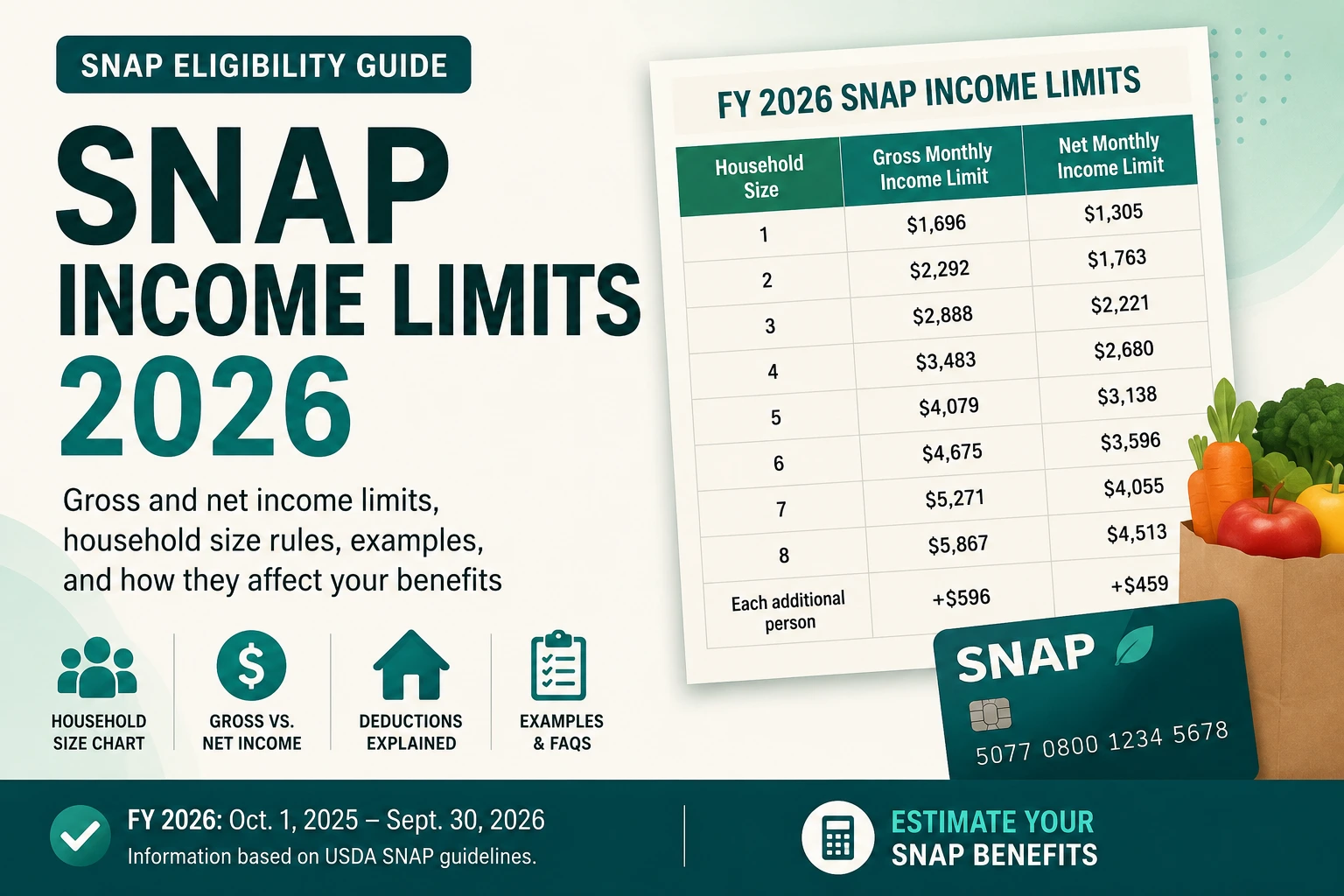
For most SNAP households in the 48 contiguous states, District of Columbia, Guam, and the U.S. Virgin Islands, the FY 2026 gross monthly income limit starts at $1,696 for one person and increases by $596 for each additional household member. The net monthly income limit starts at $1,305 for one person and increases by $459 for each additional household member.
These limits are not the only SNAP rule. Your household size, state, deductions, resources, immigration or citizenship status, student rules, work rules, and elderly or disabled household rules can all affect the final decision.
FY 2026 SNAP Income Limits Chart
The table below shows the FY 2026 SNAP gross and net monthly income limits for households in the 48 contiguous states, District of Columbia, Guam, and the U.S. Virgin Islands. These figures apply to applications between Oct. 1, 2025 and Sept. 30, 2026.
| Household size | Gross monthly income limit | Net monthly income limit |
|---|---|---|
| 1 | $1,696 | $1,305 |
| 2 | $2,292 | $1,763 |
| 3 | $2,888 | $2,221 |
| 4 | $3,483 | $2,680 |
| 5 | $4,079 | $3,138 |
| 6 | $4,675 | $3,596 |
| 7 | $5,271 | $4,055 |
| 8 | $5,867 | $4,513 |
| Each additional person | +$596 | +$459 |
Gross Income vs. Net Income for SNAP
SNAP uses two important income ideas: gross income and net income. They sound similar, but they are not the same.
Gross income
Gross income means your household’s total non-excluded income before SNAP deductions are applied. This may include wages, self-employment income, Social Security, unemployment, child support received, pensions, and other countable income.
Net income
Net income means gross income minus allowable SNAP deductions. These deductions may include part of earned income, a standard deduction, dependent care costs, certain medical expenses, child support paid, and some shelter or utility costs.
How Income Limits Affect the SNAP Calculator
The SNAP calculator uses income as one part of the estimate. It does not only look at how much money comes in. It also considers household size, expenses, deductions, elderly or disabled household details, and the state selected.
Income can screen eligibility
If gross income is far above the limit for your household size, the estimate may show that you are less likely to qualify. This can change if special rules apply.
Deductions can change net income
Rent, utilities, child care, child support paid, and medical costs for elderly or disabled members may reduce countable net income when allowed.
State rules still matter
Each state runs SNAP locally. Application systems, utility allowances, reporting rules, and verification steps can differ by state.
SNAP Income Limit Examples
These examples are simplified. They are meant to show how income limits work, not to predict an official approval or denial.
Example 1: One-person household
A one-person household in the 48 contiguous states has a FY 2026 gross monthly income limit of $1,696 and a net monthly income limit of $1,305. If the person earns $1,500 per month before deductions, the household may pass the gross income screen. The final estimate still depends on deductions, expenses, resources when applicable, and other eligibility rules.
Example 2: Four-person household
A four-person household has a FY 2026 gross monthly income limit of $3,483 and a net monthly income limit of $2,680 in the 48 contiguous states. If the household has earnings, rent, utilities, and child care costs, the gross income and net income results may look different after allowable deductions are considered.
Example 3: Household with an elderly or disabled member
A household with an elderly or disabled member may be treated differently from a household without one. Under regular SNAP rules, that household may only need to meet the net income limit. This is one reason the calculator asks about elderly or disabled household members.
Are the SNAP Income Limits Different in Alaska and Hawaii?
Yes. Alaska and Hawaii have higher SNAP income limits than the 48 contiguous states. Alaska also has special SNAP benefit maximums by area for Urban, Rural 1, and Rural 2 households.
Alaska
Alaska has higher income limits and area-based benefit maximums. If you live in Alaska, the state or calculator may need an Alaska area selection before producing a useful estimate.
Hawaii
Hawaii has higher income limits and maximum benefit amounts than the 48 contiguous states because USDA publishes separate FY 2026 standards for Hawaii.
What Deductions Can Reduce SNAP Net Income?
SNAP net income is not the same as take-home pay. It is calculated using SNAP rules and allowable deductions. These deductions are one reason two households with the same gross income may receive different estimates.
Common SNAP deductions may include
- A 20% deduction from earned income
- A standard deduction based on household size and location
- Dependent care costs needed for work, training, or education
- Certain medical expenses for elderly or disabled household members
- Legally owed child support payments in some states
- Some shelter and utility costs
- A homeless shelter deduction when applicable
Why Your State Still Matters
SNAP is a federal program, but it is administered by state agencies. That means your state matters for the application portal, interview process, document rules, reporting rules, EBT card name, and some state-specific policy details.
Application systems differ
Some states use portals like MyACCESS, ePASS, Colorado PEAK, Access Arkansas, MI Bridges, or Health-e-Arizona Plus.
Utility rules may differ
Utility allowances and shelter-cost handling can vary by state and may affect the estimate.
Final decisions are local
Your state SNAP agency or local office reviews the application and decides eligibility and benefit amount.
Should You Apply If Your Income Is Close to the Limit?
If your income is close to the SNAP income limit, applying may still be worth considering. An online estimate cannot review every document, deduction, state rule, or special situation.
You may still want to apply if:
- Your income recently dropped
- Your household size changed
- Your rent, mortgage, or utility costs are high
- You pay dependent care costs
- You pay child support
- You have an elderly or disabled household member
- You have medical costs for an elderly or disabled household member
- You are not sure which income counts
- Your state uses broad-based categorical eligibility
Related SNAP Guides
Official Sources
This guide is based on official USDA SNAP eligibility and FY 2026 cost-of-living adjustment resources. Use these links to verify current federal SNAP income standards and eligibility rules directly.
SNAP Income Limits 2026 FAQs
What are the SNAP income limits for 2026?
For FY 2026, a one-person household in the 48 contiguous states has a gross monthly income limit of $1,696 and a net monthly income limit of $1,305. A four-person household has a gross monthly income limit of $3,483 and a net monthly income limit of $2,680. Alaska and Hawaii have higher limits.
What is gross income for SNAP?
Gross income means your household’s total non-excluded income before SNAP deductions are applied.
What is net income for SNAP?
Net income means gross income minus allowable SNAP deductions. Deductions may include earned income deductions, standard deductions, dependent care, some medical costs, child support paid, and certain shelter or utility costs.
Do all SNAP households have to meet the gross income limit?
In most cases, households must meet both gross and net income limits. However, a household with an elderly or disabled member may only need to meet the net income limit under regular SNAP rules.
Are SNAP income limits higher in Alaska and Hawaii?
Yes. USDA publishes higher FY 2026 SNAP income limits for Alaska and Hawaii. Alaska also has special area-based maximum benefit amounts.
Can I qualify for SNAP if my income is close to the limit?
Possibly. If your income is close to the limit, deductions, household size, elderly or disabled household rules, and state-specific rules may affect the final decision. Applying through your official state agency is the only way to get an official decision.
Can this guide tell me if I will be approved?
No. This guide explains the FY 2026 SNAP income limits, but it cannot approve, deny, or guarantee benefits. Your state SNAP agency makes the final decision after reviewing your application and documents.
Estimate Your Possible SNAP Benefits
Use the SNAP calculator to estimate possible benefits based on household size, income, expenses, deductions, and state-specific rules.