SNAP benefit guide
SNAP Maximum Benefits 2026
SNAP maximum benefits are the highest monthly food assistance amounts a household can receive before income and deductions are applied. For FY 2026, the federal SNAP maximum benefit amounts apply from Oct. 1, 2025 through Sept. 30, 2026.
Last reviewed: May 2026. Rule period used: FY 2026, Oct. 1, 2025 through Sept. 30, 2026.
Quick Answer: What Is the Maximum SNAP Benefit in 2026?
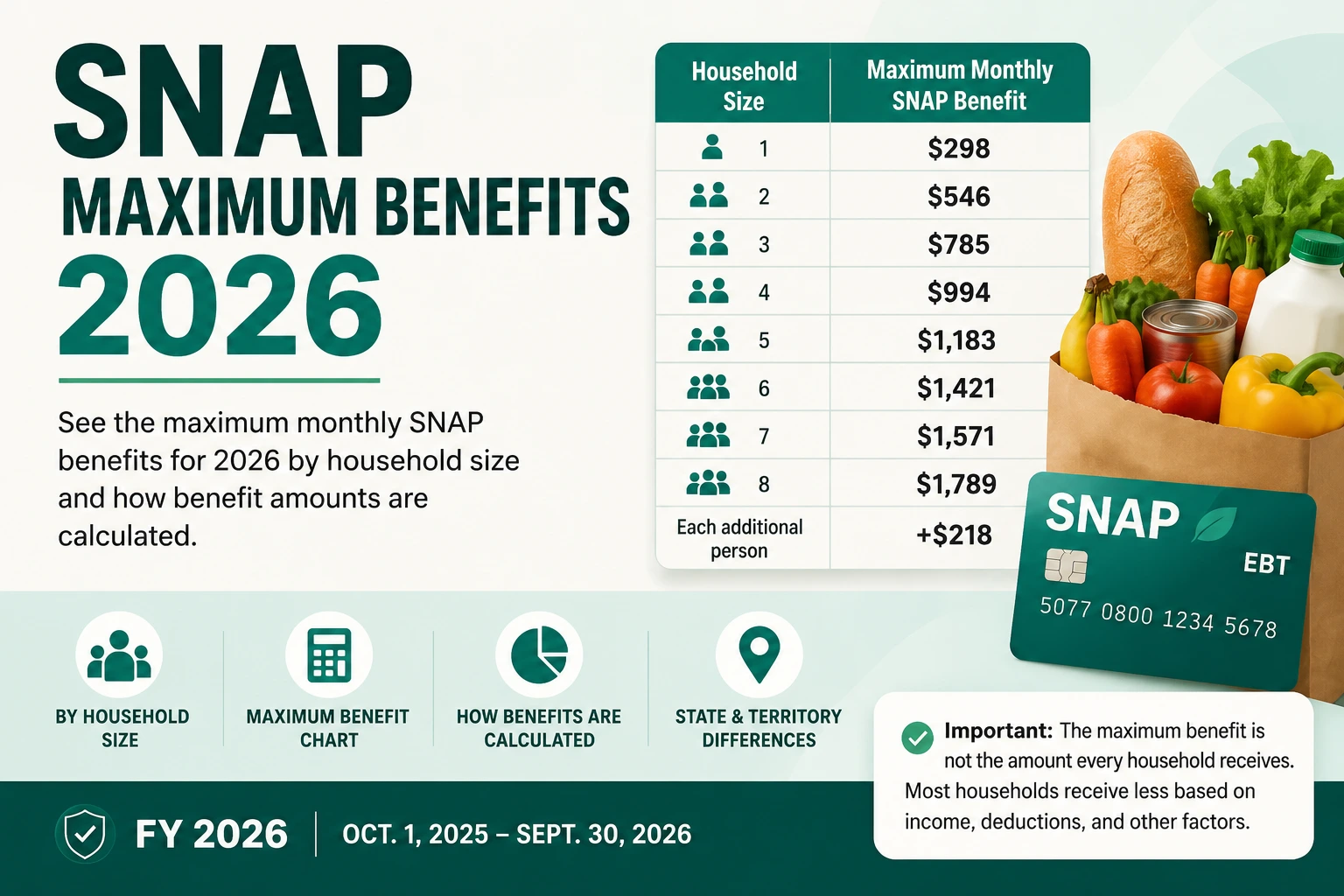
For FY 2026, the maximum monthly SNAP benefit in the 48 contiguous states and District of Columbia is $298 for a one-person household, $546 for a two-person household, $785 for a three-person household, and $994 for a four-person household.
Larger households can receive higher maximum amounts. For example, the FY 2026 maximum benefit for an eight-person household in the 48 contiguous states and District of Columbia is $1,789. Each additional person adds $218 to the maximum allotment.
FY 2026 SNAP Maximum Benefit Chart
The table below shows the FY 2026 maximum monthly SNAP benefits for households in the 48 contiguous states and District of Columbia.
| Household size | Maximum monthly SNAP benefit |
|---|---|
| 1 | $298 |
| 2 | $546 |
| 3 | $785 |
| 4 | $994 |
| 5 | $1,183 |
| 6 | $1,421 |
| 7 | $1,571 |
| 8 | $1,789 |
| Each additional person | +$218 |
What Does “Maximum SNAP Benefit” Mean?
The maximum SNAP benefit is the highest monthly amount a household of a certain size can receive under the federal SNAP allotment table for its location. It is sometimes called the maximum allotment.
It starts with household size
SNAP maximum benefits increase as household size increases. A larger household generally has a higher maximum benefit than a smaller household.
Income usually reduces the amount
SNAP benefits are usually calculated by subtracting part of the household’s countable net income from the maximum benefit amount.
Location can change the maximum
The 48 states and District of Columbia use one table, while Alaska, Hawaii, Guam, and the U.S. Virgin Islands use separate tables.
How SNAP Benefits Are Usually Estimated
A common SNAP estimate starts with the maximum benefit for your household size, then subtracts about 30% of your household’s countable net income. This is why two households with the same household size may receive different benefit amounts.
Simplified estimate formula
Maximum SNAP benefit minus 30% of countable net income equals the estimated SNAP benefit.
This is a simplified explanation. Official state agencies may apply additional rules, verification, rounding, minimum benefit rules, and state-specific details.
SNAP Maximum Benefit Examples
These examples are simplified and are not official eligibility decisions. They show why the maximum benefit is only the starting point.
Example 1: One-person household with no countable net income
A one-person household in the 48 contiguous states has a FY 2026 maximum SNAP benefit of $298. If the household has no countable net income after SNAP deductions, the estimate may be close to the maximum amount.
Example 2: Four-person household with countable net income
A four-person household has a FY 2026 maximum SNAP benefit of $994 in the 48 contiguous states and District of Columbia. If the household has countable net income, the monthly benefit estimate is usually reduced from the maximum amount.
Example 3: Household in Alaska or Hawaii
A household in Alaska or Hawaii may have a different maximum benefit than the same-size household in the 48 contiguous states. Alaska also uses different benefit levels for Urban, Rural 1, and Rural 2 areas.
Is There a Minimum SNAP Benefit?
Some one-person and two-person households may qualify for a minimum SNAP benefit instead of a larger monthly amount. For FY 2026, the minimum benefit in the 48 contiguous states and District of Columbia is $24.
Minimum benefit rules can be affected by household size, income, state processing, eligibility category, and location. A household that is eligible for SNAP may receive a small benefit if its countable net income is close to the cutoff.
Why Alaska and Hawaii Have Different Maximum SNAP Benefits
SNAP maximum benefit amounts are higher in Alaska and Hawaii than in the 48 contiguous states because USDA publishes separate allotment tables for those locations.
Alaska
Alaska uses separate maximum benefit amounts for Urban, Rural 1, and Rural 2 areas. For a useful estimate, Alaska households should choose the correct area when using the calculator.
Hawaii
Hawaii uses its own FY 2026 maximum benefit table. A Hawaii household can have a higher maximum benefit than the same-size household in the 48 contiguous states.
Why Your SNAP Benefit May Be Lower Than the Maximum
Many approved households receive less than the maximum SNAP amount. That is normal because the final benefit is based on household size, net income, deductions, and allowed expenses.
Income reduces benefits
The more countable net income a household has, the more the benefit may be reduced from the maximum amount.
Deductions can help
Allowed deductions may reduce countable net income and may increase the estimated benefit amount.
State review matters
State SNAP agencies review official documents and may apply state-specific verification, reporting, and utility rules.
Why the Maximum Benefit Is Not Guaranteed
The maximum SNAP benefit is only the top amount for a household size and location. It does not mean every approved household receives that amount.
Your final benefit can be lower because of:
- Earned income
- Unearned income
- Household size rules
- Allowable deductions
- Shelter and utility costs
- Medical expenses for elderly or disabled household members
- Student rules
- Work rules
- State verification rules
- Benefit rounding and minimum benefit rules
Why Your State Still Matters
SNAP is federally funded but administered by states. Your state can affect the application portal, EBT card name, utility allowances, document requests, reporting rules, and case review process.
Application systems differ
States use different systems such as MyACCESS, Access Arkansas, Colorado PEAK, ePASS, MI Bridges, Georgia Gateway, and Health-e-Arizona Plus.
EBT card names differ
Some states use names like Quest Card, Bridge Card, Link Card, ACCESS card, or EBT card.
Official decisions are local
Your state SNAP agency or local office makes the final eligibility and benefit decision.
Related SNAP Guides
Official Sources
This guide is based on official USDA SNAP FY 2026 cost-of-living adjustment resources and eligibility guidance.
SNAP Maximum Benefits 2026 FAQs
What is the maximum SNAP benefit for one person in 2026?
In the 48 contiguous states and District of Columbia, the FY 2026 maximum SNAP benefit for a one-person household is $298 per month.
What is the maximum SNAP benefit for a family of four in 2026?
In the 48 contiguous states and District of Columbia, the FY 2026 maximum SNAP benefit for a four-person household is $994 per month.
Does every approved household receive the maximum SNAP amount?
No. Many approved households receive less than the maximum amount because income and deductions reduce the final benefit.
Why are SNAP maximum benefits higher in Alaska and Hawaii?
USDA publishes separate maximum benefit tables for Alaska and Hawaii. Alaska also has different Urban, Rural 1, and Rural 2 maximum benefit levels.
What is the minimum SNAP benefit in 2026?
For FY 2026, the minimum SNAP benefit in the 48 contiguous states and District of Columbia is $24 for eligible one-person and two-person households.
Can the calculator guarantee my SNAP benefit amount?
No. The calculator provides an estimate only. Your state SNAP agency makes the final eligibility and benefit decision after reviewing your application and documents.
Estimate Your Possible SNAP Benefits
Use the SNAP calculator to estimate possible benefits based on household size, income, expenses, deductions, and state-specific rules.